


Our vision is life free of MFM13 and all its burden

Cure MFM13 is the only charitable project dedicated to overcoming challenges of MFM13

Learn more about MFM13

For Patients

Our Patient Registry, in collaboration with RARE-X, is now officially live!

Join our community on the RARE-X platform and help accelerate research for MFM13!

Your participation will help generate valuable data that can support research, clinical trial readiness, and future therapy development.

Icon of a hand holding a heart, symbolizing generosity.
For Clinicians
New initiative aimed at characterizing multisystem proteinopathies
Learn more
For Researchers
Drug Repurposing Resources
Visit our dedicated page

What is Myofibrillar Myopathy type 13 with Rimmed Vacuoles (MFM13)?

MFM13 is an ultra-rare, incurable genetic disorder marked by muscle wasting and progressive weakness, typically manifesting in young adults between their 20s and 40s. This slowly progressing, autosomal dominant condition is caused by a mutation in the HSPB8 gene. HSPB8 is involved in normal skeletal muscule function and repair. Muscle weakness usually, but not always, begins distally. To date, eight publications describing around 60 patients have been published.
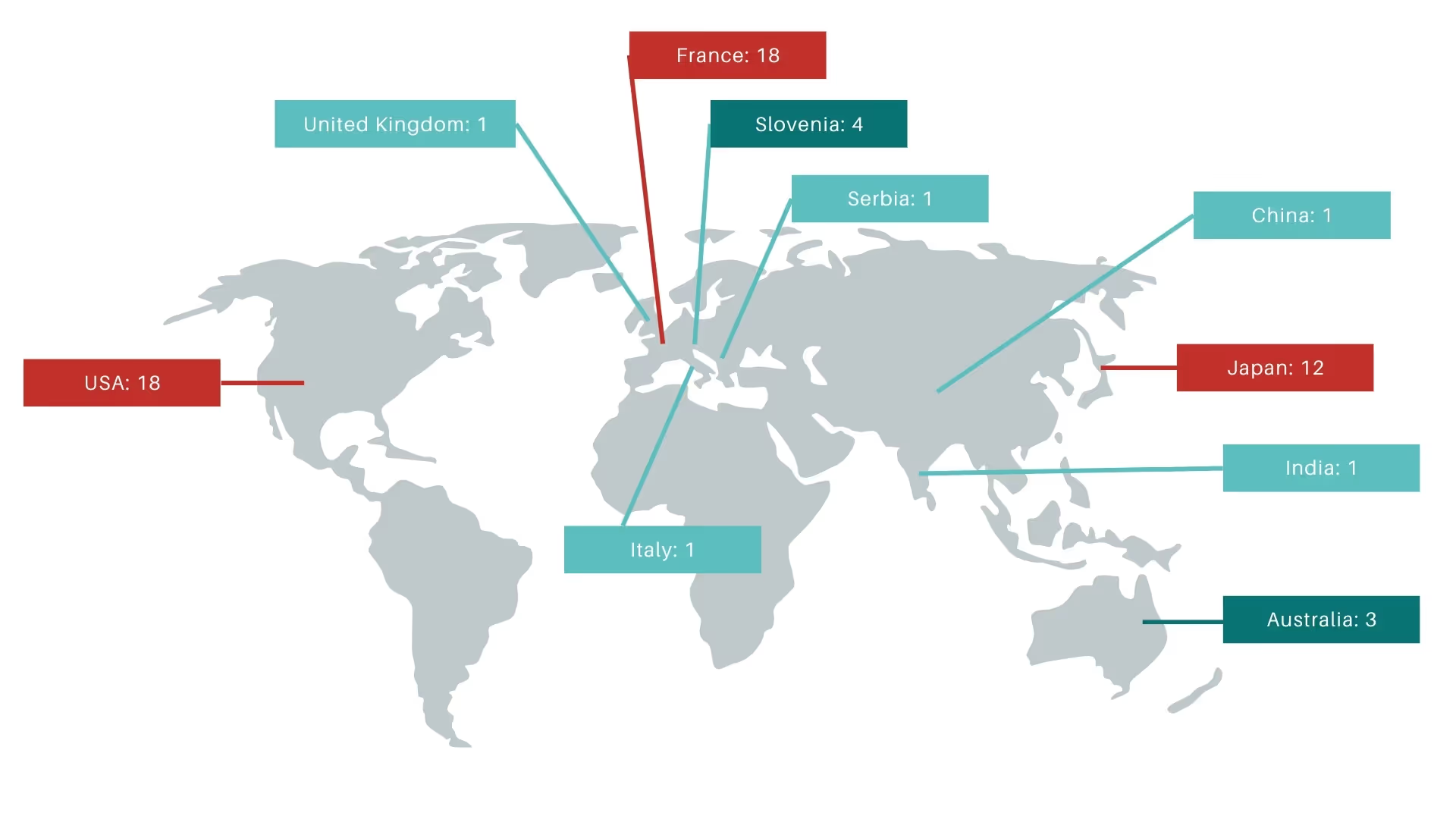
World map showing number of patients by country: USA 18, France 18, Japan 12, Slovenia 4, Australia 3, United Kingdom 1, Serbia 1, Italy 1, China 1, India 1.
MFM13 patients around the world

Cure MFM13 (previously Cure HSPB8)

We are the only charitable project dedicated to addressing the challenges of MFM13, with a vision of life free from this burden and a mission to find a cure for this debilitating condition. Our collaboration with healthcare professionals and researchers aims to unravel the complexities of MFM13. We are determined to find effective treatments and a cure, bringing hope to those affected. Equally important is our commitment to building a vibrant community for patients and families, providing a supportive space to share experiences, learn from each other, and stay informed about medical advancements.

Join us in our endeavor. Your involvement, whether as a patient living with MFM13, a family member, or a healthcare professional, is a step towards change. Together, we are stronger and can create a future where MFM13 no longer defines lives.


Myofibrillar Myopathies

To date, at least thirteen genetically distinct forms of MFM (MFM1–MFM13) have been described (Table 1). These subtypes are caused by mutations in genes encoding proteins that play essential roles in maintaining muscle structure, protein quality control, and cellular stress responses. Despite their genetic diversity, the disease mechanisms often converge on common pathways involving protein misfolding, protein aggregation, impaired autophagy, and disruption of the muscle fiber architecture (Wannarong et al., 2025, Ziemian et al., 2025, Zhou et al., 2026).

Myofibrillar myopathies (MFMs) are a group of rare inherited neuromuscular disorders characterized by progressive muscle weakness and the abnormal accumulation of proteins within muscle fibers. Although the different forms of MFM are caused by mutations in different genes, they share a common pathological hallmark: the breakdown of myofibrils, the structures responsible for muscle contraction, beginning at the Z-disk, followed by the accumulation of protein aggregates within muscle cells. These changes can be observed in muscle biopsies and are a defining feature of the disease group (Schröder et al., 2009, Selcen 2008 and 2011, Fichna et al., 2018, Inoue et al., 2025)

Individuals with MFM may experience muscle weakness affecting the arms, legs, trunk, or respiratory muscles. Some forms can also involve the heart, leading to cardiomyopathy or cardiac conduction abnormalities. The age of onset, disease severity, and pattern of muscle involvement vary considerably depending on the underlying genetic cause (Schröder et al., 2009, Selcen 2008 and 2011).

Table 1. Myofibrillar myopathy subtypes
Subtype Gene OMIM Inheritance / Onset First-description publication Former/alternative names
MFM1 DES #601419 childhood to adulthood Fardeau et al., 1978 desmin-related myofibrillar myopathy or desminopathy
MFM2A CRYAB #608810 childhood to adulthood Vicart et al., 1998 Desmin-related Myopathy ("αB-crystallin chaperone gene causes a desmin-related myopathy"); Alpha-B Crystallin-Related Myopathy; Myopathy, Myofibrillar, with or without Cataract and/or Cardiomyopathy
MFM2B (infantile) CRYAB #613869 infantile-onset Del Bingo et al., 2011
MFM3 MYOT #609200 adult-onset Hauser et al., 2000 Myotilinopathy; Limb girdle muscular dystrophy 1A; Spheroid body myopathy
MFM4 LDB3 (ZASP) #609452 adult-onset Selcen et al., 2005 Markesbery-Griggs Distal Myopathy
MFM5 FLNC #609524 Vorgerd et al., 2005 Filamin C-related filaminopathy
MFM6 BAG3 #612954 child-onset (more often) and adult onset cases Selcen et al., 2009 BAG3-related myofibrillar myopathy
MFM7 KY #617114 early child-onset Hedberg-Oldfors et al., 2016
MFM8 PYROXD1 #617258 infancy to adult-onset O'Grady et al., 2016 adult-onset limb-girdle-type muscular dystrophy
MFM9 (early respiratory failure) TTN #603689 young adult to adult-onset Lange et al., 2005 "Hereditary Myopathy with Early Respiratory Failure; (MHERF) Myopathy, Proximal, with Early Respiratory Muscle Involvement; (MPRM) Edstrom myopathy; Myopathy, Distal, with Early Respiratory Failure, Autosomal Dominant"
MFM10 SVIL #619040 infancy, child and adult-onset Hedberg-Oldfors et al., 2020
MFM11 UNC45B #619178 child-onset Donkervoort et al., 2020 Myopathy, Congenital, with Eccentric Cores
MFM12 MYL2 #619424 infancy Wetermanet al., 2013
MFM13 (rimmed vacuoles) HSPB8 #621078 adult-onset Ghaoui et al., 2013 HSPB8-related Myopathy

Cure MFM13 is dedicated to advancing research and therapeutic development for MFM13, a form of myofibrillar myopathy caused by mutations in the HSPB8 gene. While our primary focus is MFM13, many biological mechanisms are shared across the broader MFM family, including protein aggregation, impaired protein quality control, and progressive muscle degeneration (Zhou et al., 2026).

Studying other forms of MFM can provide valuable insights into common disease pathways, potential biomarkers, and therapeutic strategies that may benefit multiple patient communities. Likewise, advances in MFM13 research may contribute to the understanding and treatment of other myofibrillar myopathies.

The following pages provide an overview of each currently recognized MFM subtype (MFM1–MFM13), including the causative gene, clinical features, inheritance patterns, and key research developments.

Want to learn more?

I’m a patient

I’m a clinician

I’m a researcher

I’d like to volunteer
Your generosity can help put an end to MFM13

If you are donating by credit card, please note that Social and Environmental Entrepreneurs, or a variation of SEE, will show up on your credit card statement. Your donation is fully tax deductible.

Icon of a hand holding a heart, symbolizing generosity.