A Guide to Genetic Testing

What is genetic testing and why is it important?
Genetic testing is the main way to confirm a diagnosis of Myofibrillar Myopathy type 13 (MFM13). This testing looks for changes (called variants or mutations) in the HSPB8 gene, which are known to cause the condition.
Because MFM13 can look similar to other muscle diseases, DNA testing is the only way to make a definite diagnosis. Getting an accurate result helps your doctors:
- Understand whether other tests or screenings are needed (for example, for heart or breathing function),
- Make personalized care recommendations,
- Identify whether other family members might carry the same change,
- And provide opportunities to join research studies to help advance understanding of MFM13.
How do I get the DNA test for MFM13?
If you are interested in genetic testing for MFM13, please talk to your doctor, such as a neurologist, or genetic counselor. A genetic counselor specializes in inherited conditions and can help you understand your testing options and what the results might mean for you and your family.
Testing is usually done with a saliva sample or a small blood sample (less than one tablespoon). Results are typically available in about three to five weeks.
There are a few different ways that your doctor can order the HSPB8 test:
- Some tests look only at specific sections of the HSPB8 gene where mutations are known to occur.
- Others test the entire HSPB8 gene or include it as part of a larger panel of genes related to muscle and nerve disorders.
If another family member has already been diagnosed with an HSPB8 variant, your doctor can order a single-gene test that looks specifically for that same change.
If it’s not yet clear what is causing the symptoms, your doctor may order a multi-gene panel, which looks at many genes at once.
In many cases, HSPB8 can also be added (by request) to existing diagnostic panels such as:
- Congenital myopathy panels
- Comprehensive myopathy panels
- Distal myopathy panels
- Comprehensive neuromuscular disorder panels
Whole Exome and Whole Genome Sequencing
Sometimes, broader testing such as Whole Exome Sequencing (WES) or Whole Genome Sequencing (WGS) is used. These tests look at nearly all genes in the body and can sometimes find rare variants that smaller panels might miss.
Not every test will find the exact cause, but in our experience, GeneDx and Ambry Genetics have successfully identified HSPB8 mutations causing MFM13.
Your doctor and a genetic counselor can help you choose the best testing option and interpret the results. Doctors ordering these tests usually include detailed clinical notes and documentation to help with insurance approval.
Genetic Panel
No Cost Genetic Testing | Invitae
Patients seeking genetic testing can now apply for a free of charge testing via this link.
The test is sponsored by Invitae and covers a panel of over 230 genes for neuromuscular variants and 100 for neuropathic variants, including HSPB8.
The Gene Panels include HSPB8 and Invitae confirmed that their genetic testing can detect HSPB8 frameshift mutations.
How to apply for free genetic testing*
- Symptoms that will increase your chances of qualifying for no-cost genetic testing: weakness, muscle atrophy, high CK, abnormal EMG, or family history.
- US citizens: you need a U.S. street address (no P.O. boxes).
- Apply online: use the provided link and include as much medical detail as possible. Include in your application your primary doctor's name and contact info.
- Receive kit: a mouth swab test with instructions will be mailed to you.
- Return kit: send it back using the provided packaging.
- No income limits.
*”No costs genetic testing” availability might change and depends on financing from Invitae.
What after submitting the specimen?
- The results may take 2-4 weeks to reach you.
- The test results will be passed to your primary doctor, using contact information you shared in the application.
- Your primary doctor should verify your test results and discuss them with you.
William Lowery, MD is Founder and Chairman at LGMD-1D DNAJB6 Foundation. We are grateful that Dr. Lowery has shared no-cost genetic testing information with our community. We hope this initiative will help provide accurate diagnoses for the MFM13 community and beyond.
More information can be found on LGMD-D1 DNAJB6 Foundation website, here
Whole Exam Sequencing (WES)
Financial Assistance Program | Baylor Genetic
Patients seeking genetic testing may be eligible for free or low-cost testing through the Baylor Genetics Financial Assistance Program (FAP).
The program may reduce the cost of testing to as little as $0, depending on household income and approval of the Financial Assistance application. One patient from our community was approved for 100% financial assistance for Whole Exome Sequencing, resulting in a patient cost of $0.
The Baylor Genetics Financial Assistance Program generally requires documentation of household income. Based on our experience, federal tax return forms from 2 recent years were accepted as supporting documentation (note that all sensitive information should be removed).
The Program is designed for US citizens only.
How to apply for Baylor Genetics financial assistance
1. Apply for Financial Assistance
Complete the Baylor Genetics Financial Assistance Program application and provide the required income documentation.
About the Financial Assistance Program
Eligibility is based on household size and total annual household income. Baylor Genetics reviews each application individually.
The application asks for:
- Patient and insurance information.
- Number of people in the household.
- Total annual household income.
- Supporting documentation verifying income and household size.
According to Baylor Genetics, applicants should provide two forms of supporting documentation, such as:
- Federal tax return.
- W-2 statement.
- Two consecutive pay stubs.
- Other documentation reflects financial hardship when applicable. Wait for Approval
*Note that your federal tax return documentation from two last year can be accepted as two supporting documentations
*Applications are available in English and Spanish
More information and the Financial Assistance application can be found here:
2. Wait for approval
Baylor Genetics will review the application and notify you* if your request has been approved. Approved financial assistance may cover up to 100% of testing costs**.
* Our patients received approval 1 day after submitting the application.
** Note that you should receive email after application submission and after approval with information about the discount.
3. Contact Your Physician
After approval, contact your primary care physician, neurologist, geneticist, or other healthcare provider and ask them to order the test. Baylor Genetics requires an ordering healthcare provider to initiate testing.
4. Test Order Submission
The ordering physician will:
- Submit the test order to Baylor Genetics.
- Complete the required paperwork.
- Provide insurance information if requested.
- Coordinate sample collection and shipment5.
5. Receive the Collection Kit
Baylor Genetics can send the collection kit directly to the patient's home unless the physician prefers to collect the sample within their practice.
6. Submit Your Sample
Follow the instructions included in the kit and return the specimen according to Baylor Genetics' instructions. The physician's office may assist with this process.
What happens after submitting the specimen?
- Baylor Genetics will process the sample after it is received by their laboratory.
- Test results will be returned to the ordering healthcare provider.
- The ordering physician should review and discuss the results with the patient.
As of May 2026, results were available within approximately 3 weeks. We recommend contacting your primary care provider after this period to confirm whether the results have been received. Please be aware that processing times can vary and may take up to 8 weeks, depending on Baylor Genetics’ workload.
7. Example of the results with MFM13 diagnosis
Additional Information
For questions regarding kits, paperwork, or shipping procedures, Baylor Genetics Patient Billing Department can be contacted at 800-411-4363 (Option 2).
The Baylor Genetics Financial Assistance Program has helped members of the MFM13 community access advanced genetic testing that may otherwise be unaffordable. We hope this opportunity will help provide accurate diagnoses for individuals and families affected by inherited neuromuscular disorders.
Availability of financial assistance programs may change over time and is subject to Baylor Genetics policies and eligibility requirements.
Where else can I get tested?
Your doctor or genetic counselor can help you choose a testing laboratory.
A list of laboratories that include HSPB8 in their genetic testing panels can be found at the bottom of this page.
How does DNA testing work?
DNA from your saliva or blood sample is compared to a reference (a “normal” or “healthy” version of the gene). If a difference (variant) is found, specialists determine whether that change could cause MFM13.
There are two main reasons for testing:
- To confirm a diagnosis in someone who already has symptoms, and
- To check for a familial variant in someone with a family history of MFM13, even if they don’t have symptoms yet.
If possible, it’s best to test a family member who has symptoms first.
Once the mutation running in the family is known, testing other relatives becomes easier, less expensive, and more accurate.
Understanding your genetic test results
Genetic test results can sound complicated, but here’s what they usually mean:
- Pathogenic variant → a known disease-causing change in the HSPB8 gene. This confirms a diagnosis of MFM13.
- Likely pathogenic variant → very likely to cause disease, but more evidence is needed to be certain.
- Variant of Unknown Significance (VUS) → a change that hasn’t been seen before, and we don’t yet know if it causes disease.
If a VUS is found, doctors may recommend additional testing or checking whether other family members have the same change. Sometimes, as more information becomes available, these results are reclassified. Once a diagnosis is confirmed, testing other family members (carrier testing) is often recommended.
What happens if my test is positive?
A positive result means that a mutation causing MFM13 was found in your HSPB8 gene.
If you already have symptoms, this confirms the diagnosis.
If you don’t yet have symptoms, it means you are likely to develop the disease in the future or could pass it on to your children.
What happens if my test is negative?
A negative result means no mutation was found in the parts of the HSPB8 gene that were tested.
If your family has a known HSPB8 mutation and you test negative, this means you will not develop MFM13.
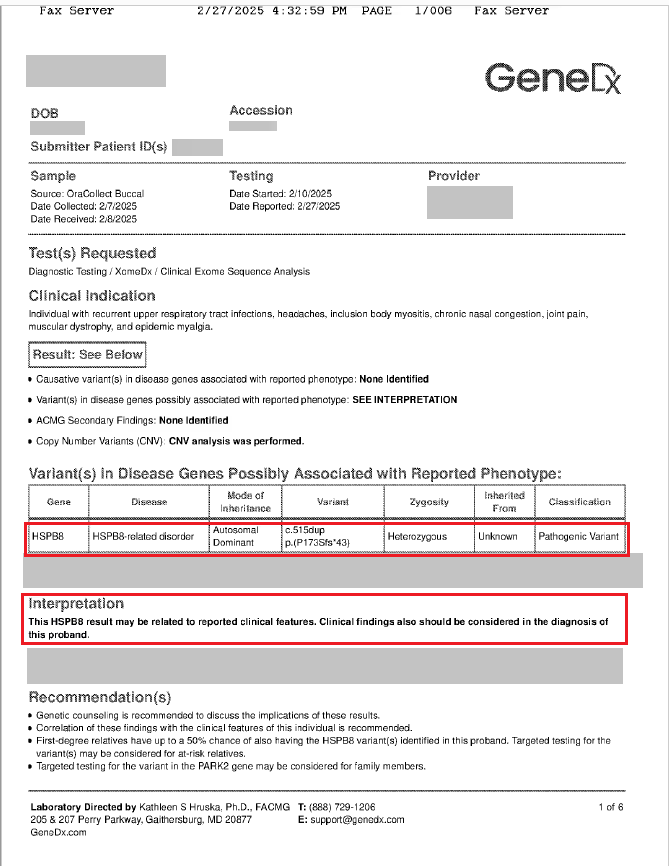
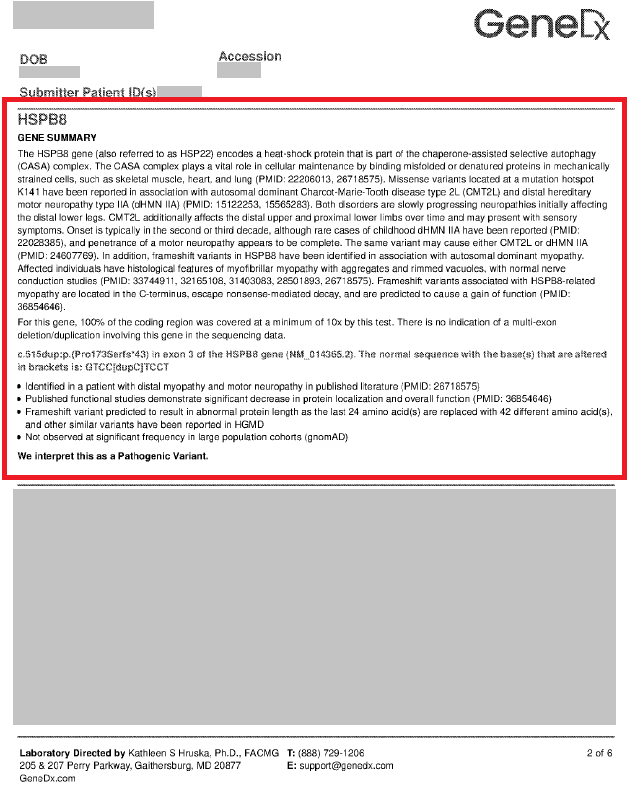
What does a genetic test report look like?
An example of a genetic test report (from GeneDx) is below
What are the risks or things to consider?
If you do not have symptoms but are considering testing, it’s important to think about what the results might mean for you and your family. Some people want to know; others prefer not to.
A genetic counselor can help you think through these questions and make an informed decision.
Concerns about discrimination based on genetic results have existed in the past, but the Genetic Information Nondiscrimination Act (GINA) passed in 2008 protects people in the U.S. from discrimination by health insurers and employers based on genetic information.
